Stargazing at Plitvice: why nights at Camping Plitvice have a special meaning
From stargazing and the Perseids to seven years of Camping Plitvice – discover why summer nights here are just as unforgettable as the days. When we plan a holiday, we usually think about what we will do during the day. But some of the most beautiful journeys actually only begin when darkness falls.
Article text
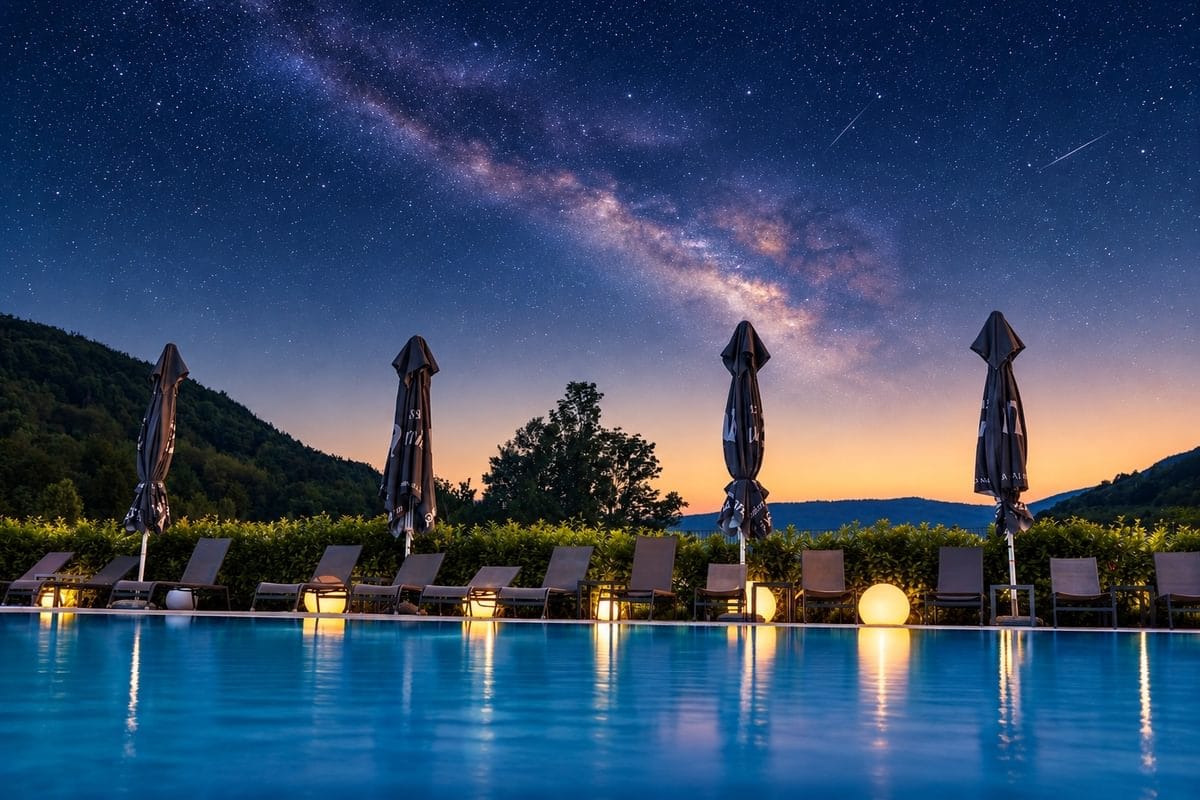
With our five quality stars and countless stars in the sky, nights at Camping Plitvice become just as special a part of the holiday as the days. In recent years more and more travellers have been choosing destinations far from light pollution, so astrotourism, travel motivated by observing the night sky and celestial phenomena, is becoming an increasingly notable form of nature tourism. Just as birdwatching teaches us to observe the life around us more carefully, stargazing invites us to turn our gaze upwards after sunset and learn to read the sky above us. And we will also share a few “tips & tricks” on how to do it.
The small charms of camping that the city can no longer offer
Countless stars above and five stars below are definitely charms of our campsite that you cannot find in the city. Above you is a sky full of stars, and below you a five-star campsite with awards that confirm its quality. Although, we agree, luxury today is no longer just a question of facilities or the number of stars. More and more often it means having more space, more privacy and more time for yourself. That is exactly why Camping Plitvice combines the best of both worlds. The comfort of modern mobile homes, pools, a restaurant, a concierge service and the amenities of boutique accommodation, but without giving up the very thing more and more people choose it for – a stay in nature. When you are comfortably settled on your own spacious terrace, with the sounds of the forest, the fresh evening air and a sky full of stars, it is easy to forget how loud everyday life really is.
Starry August at Camping Plitvice and seven years beneath the Plitvice stars
For us, the stars have an extra meaning in August. That is because on 16 August Camping Plitvice celebrates its seventh birthday. As in previous years, we are preparing a special birthday programme filled with music, socialising, guided activities, a barbecue and activities for guests of all generations. Summer with us is more than a holiday – it is a time of new encounters, shared evenings under the open sky and memories that last long after you return home. For the detailed programme of our luxury campsite’s seventh birthday, follow the Camping Plitvice Instagram profile.
When night falls, the experience is only just beginning
Astrotourism covers travel and activities linked to observing stars, planets, meteors, eclipses and other phenomena in the night sky, while stargazing is its simplest and most accessible form. We could also describe it as observing nature from a slightly different perspective – one that teaches us to pause, look up and recognise what is in the sky above us almost every evening. For your first steps in amateur astronomy you don’t even need a telescope – all you need is to find a spot away from strong lighting, put your phone away and give your eyes around twenty minutes to adjust to the dark. Research published in the renowned journal Science also shows how precious a naturally dark sky has become. Changes in the number of stars visible to the human eye showed that between 2011 and 2022 the brightness of the night sky increased by an average of 9.6 per cent a year. In other words, because of growing light pollution, the sight of a truly starry sky is no longer part of everyday life for many people.
A short guide to reading the summer sky
You may already be well acquainted with the positions of the stars in the sky, but we still bring you a few “tips & tricks” for recognising the basic landmarks of the sky. In the summer sky, one of the easiest to spot is the Summer Triangle, formed by three bright stars – Vega, Deneb and Altair. The Plough can also serve as a kind of night-time compass: if we extend an imaginary line through the two end stars on the outer edge of its “bowl”, it will lead us approximately to the North Star, the star that shows the direction of north. Orion, one of the most recognisable constellations, we leave for the colder part of the year, while August also belongs to the Perseids – the famous meteor shower that every year brings us the popular “shooting stars”. In 2026 their peak is expected on 13 August, just one day after the new moon, which will make conditions for observation particularly favourable.
Did you know that the night sky can hint at a change in the weather?
Can a starry sky also reveal what weather awaits us? A completely clear night often comes with dry and stable air, especially during periods of high pressure, but in itself it is no guarantee that the whole of the following day will be sunny. An interesting meteorological sign can be a bright ring around the Moon. It forms when moonlight passes through ice crystals in high clouds, and it sometimes signals an approaching front and a change in the weather.
The best thing of all is that stargazing has no opening hours, requires no special equipment and can begin as soon as you step out onto the terrace. Far from the noise of the city and strong artificial lighting, evenings at Camping Plitvice become an opportunity to rediscover one of humanity’s oldest views – the one towards the stars. Perhaps that is exactly why the stars have a special status here. The ones up there remind us how impressive nature can be, and these five down here how simple luxury can be. Find your place under the Plitvice stars and book your accommodation via this link.